On Friday, May 2, 2025, the Toledo Bar Association (TBA) hosted area students to celebrate Law Day at the TBA in downtown Toledo. Earlier this year, area students were invited to participate in an essay writing contest focused on the American Bar Association’s (ABA) 2025 Law Day theme, "The Constitution's Promise: Out of Many, One.” The winner of each division is awarded a cash prize by the Toledo Bar Association Foundation (TBAF) and published below. The nine winners and their teachers are listed below:
Division I: Grades 11 & 12
1st Place: Samiha Tarabishi
Toledo Islamic Academy, Teacher: Abdelkebir Elbriki
2nd Place Morgan Montrie
St. Ursula Academy, Teacher: Dennis Maas
3rd Place Medha Ramaswamy
Sylvania Southview High School, Teacher: Brian Fritz
Division II: Grades 9 & 10
1st Place: Alex Ban
Perrysburg High School, Teacher: Hua Liu
2nd Place Ria Khatri
Perrysburg High School, Teacher: Ron DeGregorio
3rd Place Ben Liu
Toledo Chinese School, Teacher: Hua Liu
Division III: Grades 7 & 8
1st Place Leah Albring
Northwest Ohio Classical Academy, Teacher: Geoff Kujawa
2nd Place Riley Witham
McCord Junior High School, Teacher: David Budas
3rd Place Kassidy Lehren
McCord Junior High School, Teacher: David Budas
Pictured left to right: Hon. Jack Zouhary, Adam Nightingale, Esq., Leah Albring, Riley Witham, Kassidy Lehren, Medha Ramaswamy, Samiha Tarabishi, and Hon. Kenneth Walz.
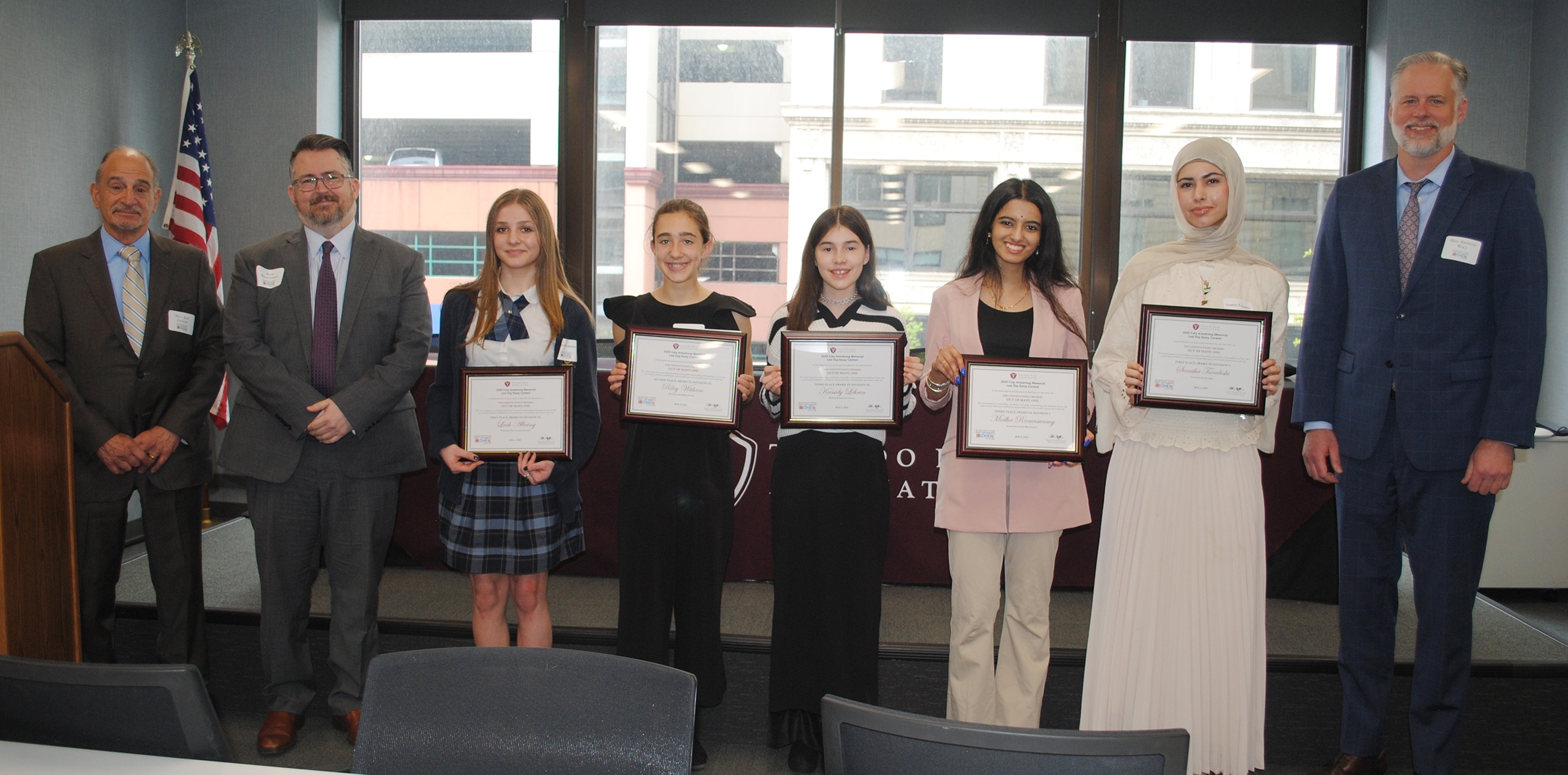
Each essay was judged based upon format, clarity, style, reasoning, creativity, and overall effort. For the first round, essays were reviewed by volunteer attorneys Anne Brossia, Valerie Fatica, Twila Ferguson, Heather Hall, Jim Hoppenjans, Bill Maloney, Florence Murray, Hon. Matthew Reger, Emily Samlow, and Kyle Silvers.
The top essays were then submitted to a judge’s panel for final review to Richard MacMillan, Holly Mathews, and Dean Rebecca Zietlow.
Hon. Jack Zouhary, U.S. District Court for the Northern District of Ohio, presented the students with awards on Friday, May 2, 2025 at the TBA’s 2025 Caty Armstrong Memorial Law Day Essay Contest Luncheon. Hon. Kenneth Walz, Lucas County Court of Common Pleas delivered the Law Day Address after the awards presentation.

Introduction to the Essay Theme:
The 2025 Law Day theme “The Constitution's Promise: Out of Many, One.” The Constitution enshrines our collective responsibility to one another, and the 2025 Law Day theme urges us to take pride in a Constitution that bridges our differences to bring us together as a united nation. Our civic lives tie us together as one "We," whether through legislative efforts that serve the common good, through military service, or by working together, every day, to fulfill the promise of E pluribus unum, or "Out of many, one."
Essay Questions (entrants chose one):
1) Unity Through Representation
How does our representative government, as established by the Constitution, ensure that the voices of a diverse citizenry are heard and respected? Discuss the strengths and current challenges of our representative system.
2) The Role of Civic Duties in Strengthening Our Union
Why are civic responsibilities, such as government service, jury service, voting, and the Census, important for maintaining a united democracy? Analyze how these responsibilities contribute to building trust and cooperation among citizens.
3) Advocacy and the Constitution
How does the Constitution empower individuals and communities to advocate for change and contribute to a more perfect union. Should public offices have term limits? How do we encourage more people to run for political office at all levels?
Division I: 11th & 12th Grades, 1st Place
E Pluribus Unum-Except for Them
by Samiha Tarabishi, Toledo Islamic Academy; Teacher: Abdelkebir Elbriki
About 1.5% of Americans today are treated as second-class citizens. For the 3.6 million Americans living in the five inhabited U.S. territories (CBPP 2024), the promise etched onto American coins, seals, and hearts remains unfulfilled. The U.S. representative system, as established by the Constitution, ensures the voices of its diverse citizenry are heard and respected. Yet, for those in U.S. territories, this system fails to provide equal representation, exposing a fundamental contradiction.
Representative democracy enables efficient governance by delegating decision-making to elected officials, allowing for timely responses to complex issues. The system also ensures the inclusion of unique perspectives by allowing citizens to elect officials who reflect their backgrounds, fostering unity amongst a diverse citizenry. It also promotes political stability through regular elections, providing a structured mechanism for leadership transitions, reducing the risk of political upheaval. Elected officials remain accountable to the public through these elections-if they fail to serve their constituents effectively, they can be voted out. Yet, despite these strengths, there are glaring cracks in the system.
While millions of Americans across the mainland enjoy full rights and representation, 3.5 million Americans in inhabited U.S. territories remain virtually voiceless. The very system that governs them still relies on colonial relics of racial discrimination: the Insular Cases-Supreme Court rulings on territories annexed following the Spanish-American War that continue to shape the lives of millions. The cases were suffused with racist language (Harvard Law 2024), referring to territories as places "inhabited by alien races" of "savage tribes," which the US had the right to acquire without conferring full constitutional protections, contrary to the US's most basic principles.
Although residents of U.S. territories have non-voting delegates in the House, their political status remains unequal. Delegates can participate in discussions but cannot vote on the House floor, restricting their influence and ability to address their constituents' needs
(Govtrack.us 2024). This marginalization is most evident in the inability of territorial residents to vote in U.S. presidential elections. Territorial residents also face unequal access to essential federal programs (Grijalva 2021). Puerto Rico, the Virgin Islands, Guam, and American Samoa are excluded from receiving Supplemental Security Income benefits, leaving the elderly, blind, and disabled without support. Assistance through the Supplemental Nutrition Assistance Program and Medicaid are also limited, straining health systems and putting thousands at risk. Furthermore, the Insular Cases violate the amendments to the Constitution that ensure the citizenship rights of people upon whom the nation had inflicted a "previous condition of servitude," according to Harvard Law in 2024.
The solution is clear: overturn the Insular Cases. Just as racial equality required national shame to move forward, so too must we force America to confront the injustices in its territories. Until we reject colonial rule embedded in the Constitution, the injustice of second-class citizenship will persist. The question is not whether history will judge us-it is whether we will continue to let this injustice stand.
Division II: 9th & 10th Grades, 1st Place
Restoring Advocacy: Empowering Citizens to Strengthen Democracy
by Alex Ban, Perrysburg High School; Teacher: Hua Liu
Engraved onto the Great Seal of the United States are the words E pluribus, Unum: Out of many, one. To uphold this principle of working together as a collective, the Constitution includes many provisions to preserve each citizens' power to advocate for change, whether it is the protection of political criticism, the enhancement of voter inclusivity, or the enactment of the 17th amendment, which established the direct election of Senators. However, driven by issues involving campaign finance, incumbency, and gerrymandering, America is slowly devolving into a society wherein regular citizens no longer hold power to effectively run for political office, thus endangering the creation of a more perfect union.
To start with, American political campaigns for public offices have increasingly become like a playground for those with pre-existing prestige to succeed. Emory Economics Review finds that "more than 90% of the highest-spending candidates in their respective districts were elected to the House of Representatives." Incumbent candidates find it easier to raise money due to their well-known names. Thus, term limits, varying by position, should be enacted to prevent long-established officeholders from gaining unfair advantages; candidates should use their policies, not their legacies, as pathways to office. Campaign finance should also be reformed. Since Citizens United vs. FEC (2010) removed restrictions on the amounts corporations could spend on political campaigns, the power of big business, wealthy donors, and Super PACs have increased drastically, at the expense of individual American voices. To make running for political office a fairer process, we should advocate to overturn Citizens United so as to amplify the voice of the average American citizen.
Gerrymandering adds to the danger by intensifying disinterest in running for political office. When congressional districts are drawn to favor a specific party, election outcomes are essentially pre-determined. Thus, qualified candidates lose faith in the democratic process and choose not to run. America should work to redraw unfair congressional lines by sticking to what is objective. First, Independent Redistricting Commissions should include citizens aligning with both parties and require a strong majority approval to formally draw congressional lines. Additionally, data-driven algorithms based strictly on a fair criterion can be utilized to assist with, but not to dictate, the redistricting process. With the abolition of gerrymandering, elections would become more competitive as they would return to being merit-based, thus empowering more individuals to contribute to democracy.
Former President Barack Obama once stated that "Change will not come ifwe wait for some other person or some other time. We are the ones we've been waiting for. We are the change that we seek." Despite the Constitution's efforts to allow each citizen to create change, due to the increasing barriers blocking ordinary American citizens from active participation in the democratic process, the wisdom of Obama's statement is growing increasingly difficult for citizens to act upon. Only when we break down these barriers by revising campaign finance regulations, eliminating gerrymandering, and establishing term limits, can America work together to consolidate a more perfect union.
Division III: 7th & 8th Grades, 1st Place
Representing Americans Through The Constitution
by Leah Albring, Northwest Ohio Classical Academy; Teacher: Geoff Kujawa
The United States Constitution advocates for and permits American citizens to participate in our government. It not only gives us the power to elect our representatives, but also empowers us to run for public office. Our constitution was constructed to encourage citizens to guide laws and policies.
The Constitution empowers American citizens. "The great genius of the Constitution is this: it permits the people to govern themselves by putting the power of the government in their hands, by protecting them from those who would take power or liberty from them, and by giving each successive generation the ability to improve upon the government bequeathed to them"
(The Genius Of The Constitution, heritage.org). The Constitution puts government into our hands through voting.
By voting and electing our representatives, expressing the right given to us in the Constitution, enables us to elect representatives to make the decisions in government. The Tenth Amendment allows for distributing power between the different branches of government. By spreading power between the legislative, executive, and judicial branches, no power or liberty is taken from us because the representatives that we vote in all have equal power. This helps us to improve upon our country and change things if need be. We are able to add or change Amendments into our Constitution; making more valid or satisfactory laws. With the Constitution, the people of our country all have equal power in deciding how to be governed.
To keep power and decision making in the hands of the people, public offices should have term limits. This would allow the power to be distributed and not the same people continuously in control. Term limits should be long enough to get done what the people want without becoming disengaged with everchanging public needs. With a fairly placed duration of time serving in public offices, elected officials would have enough time to promote what the citizens that voted them in for and are most concerned about. If they are in office for many years, even decades, that can lead to outdated decisions because newer voters and citizens won't have their voices represented.
To encourage citizens to run for office, available positions and information on how to find what position would work best for their passions and goals should be easily accessible. To run for elected government office, you need to be educated about the role and gain experience. Being active in your community, such as charity and community service work, is a great way to get experience while invoking change. Running for an elected position is a way to not only advocate for what you believe in and to carry out the work you campaigned on but also to be a voice of all citizens so they are properly heard, acknowledged, and represented.
As citizens of this country, we must educate ourselves and future generations of our constitutional republic. To honor our Constitution, while being in government, one must look beyond party lines and create the perfect union that is, Americans.
About Law Day
Law Day was established by President Eisenhower in 1958 to honor the law and is celebrated annually on or around May 1st by bar associations and the legal profession nationwide.
The essay contest for students has been an integral part of Law Day festivities for many years. This annual contest encourages youth to explore our legal system and the relationship between laws and our rights and freedoms. The Toledo Bar Association contest was named the Caty Armstrong Law Day Essay Contest after Caty’s tragic death in an automobile accident in 1993 just weeks after she was recognized as an essay contest winner.
The TBA’s Law Related School Education Committee’s mission is to develop and implement programs designed to assist all levels of our educational system in the education of students in our community about the legal system and the system of justice, including the organization of various Law Day activities and Mock Trial programs.
About the Toledo Bar Association
The Toledo Bar Association (TBA) is a voluntary professional association of lawyers in Lucas and surrounding counties. It was established in 1878 and has over 1,500 members. The mission of the TBA is to advance the highest standards of excellence for the legal profession, promote the rule of law, facilitate equal access to justice, and consciously foster a diverse and inclusive legal community, by providing unmatched collaborative opportunities, professional development and outstanding services to our members while also supporting the community at large.