Site Login

Site Login

Your Center For TBA News


154 Posts found
Previous • Page 2 of 16 • Next
Posted by: Carla Leow on May 5, 2026

2026-2027 Nominations

Second Vice President:
Evy M. Jarrett

Secretary: 
Karl. E. Strauss
  
Treasurer: 
Jeremiah P. O’Brien
  
Board: 
Sarah R. Anjum
Gordon R. Barry
Mag. Christy L. Cole
Kimberly A. Conklin
Matthew D. Harper
Charles Hatch
Kayla L. Henderson
Samantha M. Meiers
  
The 2026 Annual Meeting will be held on Tuesday, June 9, 2026.
Under the Toledo Bar Association Code of Regulations, First Vice President Robert C. Tucker, will become president for 2026-2027.  
 
Electronic Voting
In accordance with Article VIII, Section 2, a ballot and instructions for voting will be sent to the members by electronic means, on or about May 6, 2026.

  • All full members and retired members of the Toledo Bar Association will receive a ballot via the email address on file with the TBA. 
  • Biographies of each candidate will be posted on the Toledo Bar’s website, linked above. 
  • A personal link will be generated for each member to the ballot on the TBA’s polling site. Links are not transferable and may be used only once. 
  • Voting is completely anonymous and secure. 
  • Members who do not have an email address or who may be inconvenienced by electronic voting may request a paper ballot to be mailed. Please contact Carla Leow at 419-244-1044 or cleow@toledobar.org. 
  • Questions may be directed to Toledo Bar Association Executive Director, Brad Lagusch, at 419-242-9363 or blagusch@toledobar.org
Posted by: Carla Leow on Apr 29, 2026

On Wednesday, April 29, 2026, the Toledo Bar Association (TBA) hosted area students to celebrate Law Day at the James M. Ashley and Thomas W. L. Ashley United States Courthouse in downtown Toledo. Earlier this year, area students were invited to participate in an essay writing contest focused on the American Bar Association’s (ABA) 2026 Law Day theme, "Rule of Law and the American Dream.” The winner of each division is awarded a cash prize by the Toledo Bar Association Foundation (TBAF) and published below. The nine winners and their teachers are listed below:

Division I:          Grades 11 & 12
1st Place:           Alexander Malloy

                                Whitmer Senior High School, Teacher: Matt Berman
2nd Place            Saleh Awwad
                                Sylvania Northview High School, Teacher: Kylie Wilczynski
3rd Place            Asher Hassell
                                Sylvania Northview High School, Teacher: Kylie Wilczynski

Division II:         Grades 9 & 10
1st Place:            Sarah Ali

                                Maumee Valley Country Day, Teacher: Daniel Cohen    
2nd Place            Ben Lui
                                Chinese Center of Toledo, Teacher: Hua Liu  
3rd Place             Luke Oberlin
                                Maumee Valley Country Day, Teacher: Daniel Cohen 

Division III:         Grades 7 & 8
1st Place             Aurelia Cavalieri-Heller

                                Ottawa Hills Junior High School, Teacher: Dylan Bush
2nd Place            Elizabeth Hoppenjans
                                Anthony Wayne Junior High School, Teacher: Kate Karchner
3rd Place             Rowen Kusner
                                 Anthony Wayne Junior High School, Teacher: Steve Varga


Division I Winners (pictured left to right): 2nd Place - Saleh Awwad, Sylvania Northview High School; 3rd Place - Asher Hassell, Sylvania Northview High School; 1st Place - Alexander Malloy, Whitmer Senior High School


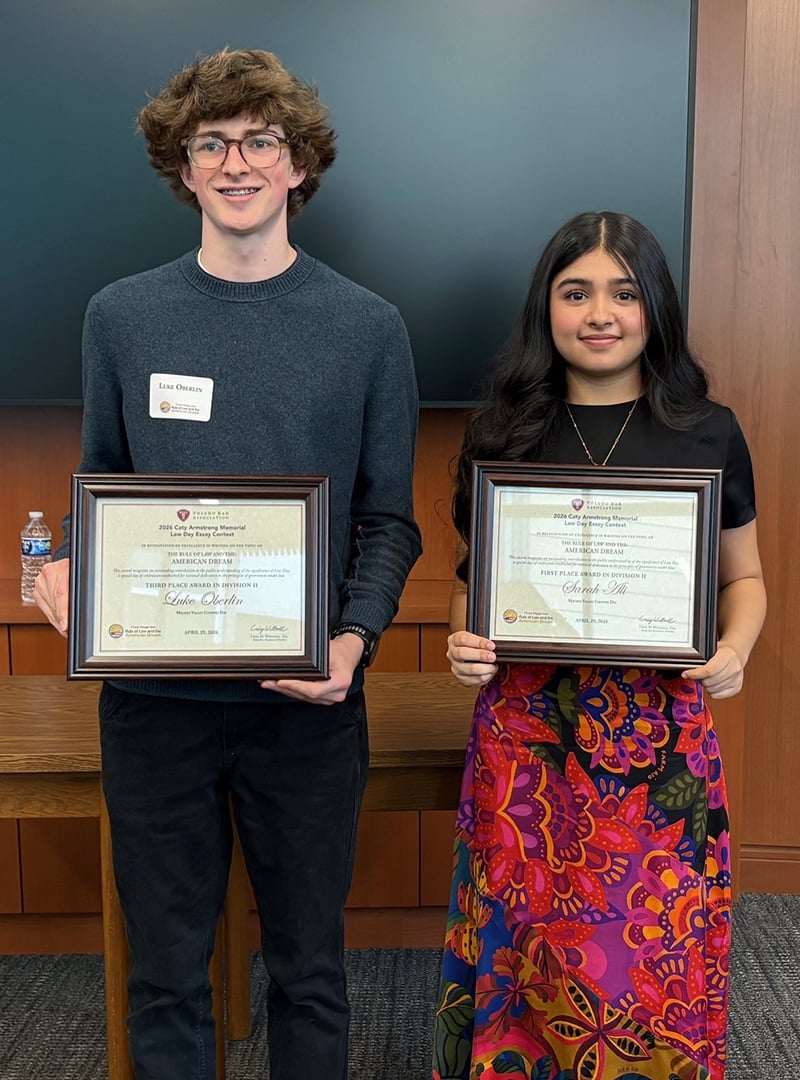
Division II Winners (pictured left to right): 3rd Place - Luke Oberlin, Maumee Valley Country Day School; 1st Place - Sarah Ali, Maumee Valley Country Day School; (not pictured) 2nd Place - Ben Liu, Chinese Center of Toledo
 

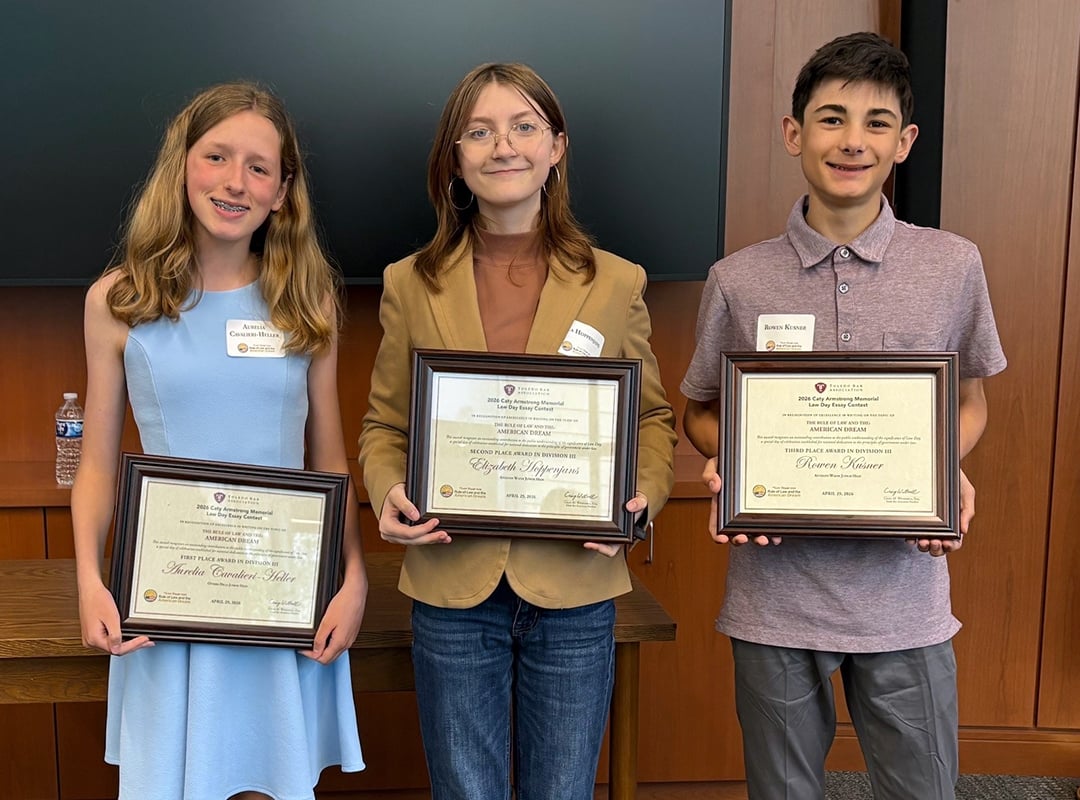
Division III Winners (pictured left to right): 1st Place - Aurelia Cavalieri-Heller, Ottawa Hills Junior High School; 2nd Place - Elizabeth Hoppenjans, Anthony Wayne Junior High School; 3rd Place - Rowen Kusner, Anthony Wayne Junior High School
 

Each essay was judged based upon format, clarity, style, reasoning, creativity, and overall effort. For the first round, essays were reviewed by volunteer attorneys Twila Ferguson, Martin E. Goff, Jocelyn Groll, Emily C. Samlow, and Robert J. Worthington.

The top essays were then submitted to a judge’s panel for final review to Hon. Stacy Handley Cook, Hon. Ian B. English, and Hon. Eric Allen Marks.

Hon. Jack Zouhary, U.S. District Court for the Northern District of Ohio, opened the program with remarks on the history and significance of Law Day. Hon. Darrell A. Clay, U.S. District Court for the Northern District of Ohio, presented awards to students. Following the awards presentation, Judge Clay delivered the Law Day Address.


Introduction to the Essay Theme:
From the nation's earliest days, the promise of America has been rooted in the idea that all people are equal under the law. The 2026 Law Day theme, "The Rule of Law and the American Dream," highlights how our constitutional framework protects the rights and freedoms that allow each person to pursue their own path. By ensuring that no one is above the law, our system promotes fairness, stability, and opportunity. this year, we invite students to consider how the rule of law helps turn aspirations into reality.
 

Essay Questions (entrants chose one):

1) How does the rule of law protect individual rights and ensure that everyone has a fair chance to pursue the American Dream?

2) What challenges threaten the rule of law today, and how might those challenges affect opportunities for future generations?

3) What responsibilities do citizens have to help uphold the rule of law, and how do those responsibilities support the American Dream?


Division I: 11th & 12th Grades, 1st Place
What challenges threaten the rule of law today, and how might those challenges affect opportunities for future generations? 
Alexander Malloy, Whitmer Senior High School; Teacher: Matt Berman

Within the new administration and polarizing political climate, the rule of law (the belief that all are equal before the law) is now at risk. The system we have loved, cherished, and fought for is at risk, and we need to fight for it.

Trust in the legal system has, and always will be, strained; that is a fact no one denies. However, this has only worsened over the past couple of years. The courts of the United States of America have a constitutional duty to uphold the law, check other branches of government, and ensure that all citizens, from the worst to the best, are given the full rights, protections, and safety of the law. However, this duty has been attacked by government officials. The executive branch has pulled funding for programs originally approved by Congress, which violates the rule of law, because this means the executive branch can pick and choose which laws it wants to enforce. This was done because the Bar Association dared to defend courts and lawyers, while also expressing views on membership and actions in court, including filing a lawsuit against Trump's administration for its efforts to undermine judicial independence. This is also seen with the threats of impeachment and accusations on those in the judiciary and legal professions, like judges, because they had opinions separate from the actions of the executive branch, and penalizations on those who try to eliminate biases in our court system, which was seen in March when Trump called for the impeachment of a judge who ruled against his deportations.

But what does this mean for our future? These accusations and threats of impeachment, bias, and disinformation continue to destroy the little trust that the American people have in our legal system. This distrust and attacks strike at the very core of our courts, which is the thought that they should be able to decide verdicts only from the rule of law, and that attorneys should be able to fight for any person, free from retaliation. "The law does not protect itself; it survives because those sworn to uphold it have the courage to do so." (Kauffman, 2025) With some attorneys admitting that "Well, I've been struggling for years." (Kauffman, 2025) And with all these attacks, how do we expect it to get better?

People often say that we need to fight for our courts and the rule of law in America. But there's an issue with that statement. If the people do not trust our system, how can we expect them to fight for our courts when they already think that the system will just abandon them? This is shown by the fact that 66% of the population has had at least one legal issue in the past four years, and only half of those problems have been solved. How are we supposed to fight for courts in America when simply using our free speech or speaking out against federal officials can be met with unchecked violations? 


Division II: 9th & 10th Grades, 1st Place
Threats to the Rule of Law
Sarah Ali, Maumee Valley Country Day School; Teacher: Daniel Cohen

When the law fails to restrain power, it becomes a weapon rather than a safeguard. As political philosopher Montesquieu warned, “There is no crueler tyranny than that which is perpetuated under the shield of law and in the name of justice.” His warning captures how abuse of power poses a fundamental threat to the rule of law when authority is exercised without restraint. Today, the rule of law is being directly tested by the normalization of political violence as a tool of power, executive overreach and the suppression of dissent.

A key threat to the rule of law is when a leader fails to respect constitutional limits and uses power for personal gain, such as rejecting the legitimacy of the electoral college. In How Democracies Die, Levitsky and Ziblatt highlight that refusal to accept election results and toleration of political violence threaten democracy. The January 6th insurrection illustrates how democracy is targeted when political figures reject the rule of law: rioters stormed the Capitol and assaulted police. In response, President Trump commended rioters and granted many pardons when re-elected, framing them as victims of unfair prosecution. In this example, political violence is used to enhance an individual’s power and undermine the rule of law.

Another major factor affecting the rule of law is the Executive branch’s use of power to silence dissent. Legal scholar Kim Lane Scheppele describes “authoritarian legalism” as a system in which governments maintain formal legality while hollowing out substantive rights; legal mechanisms are used to entrench power, sideline opposition, and suppress dissent, all while maintaining the appearance of legality. For example, protests throughout the United States against ICE have led to extreme brutality.

Recently, an ICU nurse was murdered for attempting to protect a woman being detained by ICE. He started filming ICE officers, and ended up being pushed to the ground and shot at least IO times. There is no justification for this kind of violence, yet ICE is given immunity to do whatever it feels is necessary in order to detain people. The suppression and murder of peop]e, to some, seems justified because ICE is an executive agency and should be permitted to weed out the abundance of illegal aliens. However, the brutality and force used by this agency completely obliterates the rights of citizens to stand up for what they believe. This is an example of authoritarianism masked by the creation of an “official” executive agency.

Although there are many challenges to the rule of law in the United States, rejecting legitimate election results, encouraging or excusing political violence, and suppressing dissent undermine the rule of law at its core. According to Fukuyama, institutional decay produces systems that exist in form but not in function (Fukuyama, 14). Unless these trends are addressed, future generations will inherit legal systems that promise fairness and equality but Jack substance. Preserving the rule of law requires not only recognizing these dangers but actively defending our core values of neutrality, clarity, and equal application for all.


Division III: 7th & 8th Grades, 1st Place
Denial of Due Process in Immigrant Deportations Threatens the Rule of Law and the Future of the American Dream
Aurelia Cavalieri-Heller, Ottawa Hills Junior High School; Teacher: Dylan Bush

One of the main challenges threatening the rule of law in the United States is the lack of due process in immigration deportation. Recently deported immigrants have been denied fair hearings, and the presidential administration has ignored judicial orders. Additionally, the law that President Trump is relying on for justification, the Alien Enemy Act of 1798, was designed to be used during wartime, so whether it is being used appropriately has caused controversy. For our nation of immigrants, this undermines the American dream.

In April President Trump said, “We’re getting them out, and a judge can’t say, ‘No, you have to have a trial.”’ This clearly violates a fundamental constitutional principle, which is that every person deserves a fair trial. His reasoning is that due process for every immigrant would take too long.1 He’s not wrong that it would be a slow process, but making sure that all people have a judicial hearing and a chance to plead their case is more important. The due process clause provides that “nor shall any state deprive any person of life, liberty, or property, without the due process of law.” The 1953 Supreme Court case of Kwong Hai Chew v. Colding held that “once an alien lawfully enters and resides in this country he becomes invested with the rights guaranteed by the Constitution to all people within our borders.” Both of these sources prove that due process applies
to both citizens and non-citizens.

A federal judge in June ruled that the deportation of 140 Venezuelan immigrants violated their due process rights. When a judge ordered the plane with the Venezuelans to be turned around and brought back to the United States, the administration ignored the order. While President Trump has invoked the Alien Enemy Act, which allows for illegal immigrants to be “apprehended, restrained, secured, and removed as alien enemies” during a “predatory incursion” or a “declared war” by any foreign government, not allowing immigrants to contest deportations before being deported makes it unclear whether the law was properly followed. Additionally, since this law is only supposed to be used during wartime or a predatory incursion, there are doubts whether the law even applies to the current situation, as it has previously only been invoked during actual war, such as the War of 1812 and World War II.

The lack of due process in immigrant deportations is threatening the rule of law in the United States and limiting opportunities for future generations. While many of the victims aren’t citizens, the fact that our president is so willing to undermine the Constitution should be a warning to everyone. In a country where a large part of the modern American dream is simply living in the United States, this challenge affects opportunities for future generations by preventing immigration to our country. Additionally, many of the children of these immigrants are U.S. citizens due to birthright citizenship, so deporting their parents denies them the chance of living the American dream even though they are already citizens.
 
1 ‘We cannot give everyone a trial, because to do so would take, without exaggeration, 200 years.” Broadwater, Luke, “Trump Challenges Migrants’ Due Process Rights, Undercutting Bedrock Principle.” The New York Times, April 24, 2025.


About Law Day
Law Day was established by President Eisenhower in 1958 to honor the law and is celebrated annually on or around May 1st by bar associations and the legal profession nationwide.

The essay contest for students has been an integral part of Law Day festivities for many years. This annual contest encourages youth to explore our legal system and the relationship between laws and our rights and freedoms. The Toledo Bar Association contest was named the Caty Armstrong Law Day Essay Contest after Caty’s tragic death in an automobile accident in 1993 just weeks after she was recognized as an essay contest winner.

The TBA’s Law Related School Education Committee’s mission is to develop and implement programs designed to assist all levels of our educational system in the education of students in our community about the legal system and the system of justice, including the organization of various Law Day activities and Mock Trial programs.

About the Toledo Bar Association
The Toledo Bar Association (TBA) is a voluntary professional association of lawyers in Lucas and surrounding counties. It was established in 1878 and has over 1,500 members. The mission of the TBA is to advance the highest standards of excellence for the legal profession, promote the rule of law, facilitate equal access to justice, and consciously foster a diverse and inclusive legal community, by providing unmatched collaborative opportunities, professional development and outstanding services to our members while also supporting the community at large.

Posted by: Carla Leow on Apr 27, 2026

AI for a Healthy Future and Nursing Across State Lines


AGENDA

5:00 p.m.      Registration              

5:20 p.m.      Welcome and Introductions

5:30 p.m.      Medical Legal Update

Patrick B. Cavanaugh, JD, Eastman & Smith, LTD

Andrea A. Rodriguez, JD, Eastman & Smith, LTD

  • Learn the latest legal developments in Ohio Medical Malpractice
  • Explain how recent legal developments may impact liability and claims
  • Best response to new legal developments

5:50 p.m.      Medical AI: Past, Present and Future

                       William McCreary, PhD, LLM, MBA, MA, MS, BS

  • Describe the AI principles that drive and make possible the application of technology to medicine
  • Evaluate the level of risk with new clinical technology that relies on AI, by being able to better separate the hype from reality
  • Analyze the implication for AI in healthcare as related to issues associated with overrelince on the technology and overlooking unintended consequences

6:20 p.m.      Medical-Legal Ramifications of AI

                       Ryan Sadeghian, MD, MBA, MSc, FAAP

  • Describe Key types of AI and their current applications in medical and surgical practice
  • Evaluate how AI can enhance clinical and surgical workflows, including decision support, imaging, and robotic assisted procedures
  • Assess the limitations, risks, and legal considerations associated with the use of AI in patient care
  • Apply best practices for safely integrating AI into clinical workflows while maintaining physician accountability

6:50 p.m.        Break

7:05 p.m.        AI's Interface with EMR, an EPIC Demonstration 

                          Brian Miller, MD

  • Review the current and near-future AI tools available to clinical providers to support medical decision making
  • Review non-clinical AI tools utilized in healthcare administrative functions
  • Demonstrate ambient dictation AI use in patient encounter
  • Compare the impact of healthcare AI on quality, safety, and the overall patient experience

7:25 p.m.            Q&A

                              Moderator, Patrick B. Cavanaugh, Esq., Eastman & Smith, LTD.


  • Roundtable discussion with speakers

7:45 p.m.             Break

8:00 p.m.             The Nurse Licensure Compact and Interprofessional Practice: What Every Clinician Needs to Know

                               Kristie Gallagher, DNP, RN, CEN, CPEN, TCRN, EMTP, EMSI, FAEN  


  • Describe key provisions of the Nurse Lecensure Compact (NLC)
  • Explain how NLC impacts interprofessional collaboration
  • Apply NLC principles to practice scenarios

9:00 p.m.       Evaluation & Adjournment

REGISTER NOW
 

Thank you to our sponsors!

Posted by: Carla Leow on Apr 9, 2026


Understanding Marsy's Law in Ohio — Evolving Interpretation and Practical Impacts for Attorneys
1.0 General Credit Hour

May 12, 2026
12 - 1 PM

Live In-Person Seminar
Toledo Bar Association, 2nd Floor

Presenters:

  • Hon. Matthew Reger, Wood County Court of Common Please
  • Hon. Gene Zmuda, Sixth District Court of Appeals

Since taking effect in 2018, Marsy’s Law has significantly reshaped victims’ constitutional rights in Ohio, and courts continue to refine how those rights operate in practice. This program provides an up-to-date overview of the amendment’s core protections—notice, participation, privacy, and restitution—and examines how recent Ohio Supreme Court and appellate decisions have clarified victims’ standing, the enforceability of privacy provisions, and the limits of victims’ independent participation in criminal proceedings.

REGISTER
 

This seminar is sponsored by:

State Bank


Posted by: Carla Leow on Apr 2, 2026

As part of the First Gen Lawyer’s Project, Toledo Bar Association member Karl Strauss, Esq., interviews Vallie T. Bowman-English, Toledo Municipal Clerk of Court, about her career journey and the path that led her to the practice of law. 

LISTEN TO PODCAST

Through meaningful mentorships, programming and podcasts, the TBA hopes to create a network of resources and connections to help first generation attorneys and law students establish their careers and find a home within the Toledo legal community. Learn more about the First Gen Lawyer's Project at www.toledobar.org/firstgen.

Posted by: Carla Leow on Mar 12, 2026

The NextGen Bar Exam: What It Means for Law Students


By Emily Ramsey

Beginning in 2026, law graduates across the United States will face a significantly different path to legal licensure as the National Conference of Bar Examiners (NCBE) rolls out the NextGen Uniform Bar Examination. Forty-seven states, four territories, and the District of Columbia have announced, as of February 2026, their adoption of the NextGen Bar Exam, marking one of the most substantial changes to attorney licensure in decades. The first NextGen Bar Exam will be administered in July 2026, with all adopting jurisdictions expected to complete the transition by July 2028.

The NextGen Bar Exam is designed to respond to long-standing criticism that the traditional bar exam emphasized memorization and speed over real-world lawyering skills. Under the new format, the exam shifts toward a skills-based assessment model administered over a day and a half. According to the NCBE, the redesigned exam is intended to better reflect how lawyers actually work by integrating doctrinal knowledge with legal analysis, writing, research, and client counseling.

In addition to altering the format, the NextGen exam narrows the list of tested subjects to a smaller group of foundational doctrinal areas. While the precise contours of the exam continue to evolve, the overall goal is clear: to assess whether new graduates can apply legal principles in practical, client-centered scenarios rather than simply recall large volumes of memorized information.

Students at the University of Toledo College of Law have expressed mixed reactions to the upcoming change. Some welcome the emphasis on practical skills, viewing it as a more realistic measure of readiness to practice. Others, however, are uneasy about preparing for an exam that has yet to be widely administered.
“It’s hard to study for something when there isn’t a clear roadmap,” said a first-year law student. “With the UBE, you know what to expect. With NextGen, everything feels uncertain.”

That uncertainty is compounded by the staggered adoption timelines across jurisdictions. Students graduating in the same class may face entirely different licensing exams depending on where they plan to practice. Some may sit for the traditional Uniform Bar Exam, while others take the new NextGen format.

“It’s strange knowing that people I’m studying with every day could be taking a completely different exam,” said a second-year student. “We’re in the same classes, but the finish line looks different for everyone.”

At the University of Toledo College of Law, students sitting for the Ohio or Michigan bar after July 2027 will be among the first in the region to take the NextGen exam. Most current third-year students and many second-year students are expected to take the traditional UBE. However, students graduating later in the transition period—or those who must retake the exam—may instead face the NextGen format. This creates an unusual scenario in which members of the same graduating class could prepare for different licensing exams depending on timing and jurisdiction.

As jurisdictions continue their transition, law schools and students are watching closely. Whether the NextGen Bar Exam ultimately improves legal licensure or simply reshapes its challenges will become clearer once the first cohorts sit for the exam in 2026. For now, students must prepare not only for the practice of law, but for a licensing landscape that is actively evolving.

Posted by: Carla Leow on Mar 9, 2026

The Heart of Toledo Law: Student Leadership & Community


By Nevaeh Johnson

Law school is demanding by nature and as a result it is extremely easy to succumb to the stress of it all. At The University of Toledo College of Law, our student organizations serve as an essential source of connection, advocacy, and surviving. These organizations provide students with opportunities to engage with the law beyond the learning we do in the classroom, serve the Toledo community, and build relationships that last throughout the rest of our careers. 

When I became the first Biracial Black woman to serve as Student Bar Association (SBA) President, I was deeply aware of the importance of community, especially in a space as mentally challenging as law school. I also understood as a first-generation law student how important it is to pursue the interests that brought you to law school to begin with. From the beginning of my presidency, my goal has been to create an environment where students of all interests, backgrounds, and commitments, felt heard, supported, and empowered to build community around the things they care about. The Student Bar Association plays a central role in supporting this culture. Our SBA is entirely independent and receives no funding from the university. As a result, every event hosted by SBA, or funded by SBA, is made possible through student fees and intentional collaboration. This structure allows student leaders to directly respond to student needs without outside pressure. 

All of our student organizations dedicate their time to supporting their community. OUTLaw hosts one of the largest SBA sponsored organization events every school year, the Shows for Clothes Drag Show. This event brings together students, local attorneys, and faculty for performances that celebrate self-expression, inclusion, and joy. OUTLaw also extends its mission beyond our building with events such as its upcoming Name Change Clinic, which will assist members of the local community in navigating the complicated legal process of changing their names with the assistance of our legal clinics. 

The Women’s Law Student Association (WLSA) has remained dedicated to service and collaboration. One recent highlight was its partnership with the Toledo Women’s Bar Association, during which members packed period products for girls and women in need throughout Toledo. Delta Theta Phi continues their long tradition of service through its commitment to giving back. Most recently, their members volunteered at the Toledo Northwestern Ohio Food Bank, sorting and organizing goods for distribution. 

The Black Law Students Association (BLSA) is hosting a full month of events during Black History Month, including a Black History Bake Sale and its Ben Davis Speaker Series, featuring attorneys Shawn Nelson and Lafe Tolliver. Their biggest event of the year is coming up on April 13th, the Torrence Green Scholarship Banquet. This event brings together our local legal community, as well as students for a night of networking and building connections in honor of the late Torrence Green. 

The Latino Law Student Association aims to foster a collaborative environment that champions increased Latino representation at the University of Toledo College of Law. They strive to curate meaningful events that engage alumni and celebrate the richness of their heritage. They often seek to collaborate with organizations both within and beyond the law school to amplify their collective voice and remain responsive to the evolving social and political needs of their community. 

Toledo Law students also regularly engage with the legal community beyond Ohio. The International Law Society recently traveled to New York City to attend International Law Weekend, giving students the chance to discuss global legal issues with global practitioners. As a team, Sports Law Society took a trip to the Tulane International Baseball Arbitration Competition. The organization stated that the competition taught them how deep preparation, adaptability, and collaboration matter in high-pressure, real-world advocacy settings. The competition showed them that success in advocacy depends not just on knowing the law, but on teamwork, poise, and the ability to think on your feet. 

This year has also seen the growth of new organizations, including the Immigration Law Association, the American Constitution Society, and the Asian Pacific American Law Students Association, giving more students the opportunity to find their community and pursue their interests. 

At its core, the strength of Toledo Law is in its students and their willingness to build community together. It’s one of the things that make Toledo Law so special. Through independent funding, intentional leadership, and the dedication of our student organizations, SBA remains committed to ensuring that law school is not just a place of constant high-pressure and stress, but a place where students can do what they came to law school to do. As SBA President, I am proud of the leadership, service, and collaboration demonstrated by our student organizations and I am grateful for the continued support of the local legal community in fostering the next generation of amazing attorneys.     

Posted by: Carla Leow on Mar 5, 2026

Rule of Law, Access, & Justice: The Enduring Mission of UToledo College of Law


By Dean Rebecca E. Zietlow

In today’s chaotic world of legal uncertainty, law schools are more important than ever. Our mission at UToledo Law is to address this chaos and provide an opportunity for our students to solve the pressing problems of today. In this effort, we are driven by three principles - promoting the rule of law, expanding access to legal education and committing to access to justice and service in our community.

First, all law schools promote the rule of law. We do that by teaching students legal principles, and how to use law as a non-violent way to resolve disputes. At UToledo, students learn not just how to advocate for their clients, but how law underpins our democracy, our civil society, and our everyday lives. We promote the rule of law not only by teaching about the law, but also by celebrating the “Toledo Way.” That means lawyers treat each other with collegiality and respect. We stand by our word. We hold ourselves—and each other—to the highest standards of professionalism and integrity. And we instill those values in our students.

Our faculty contribute as well, not only in the classroom but through nationally recognized scholarship. They’re tackling pressing legal challenges, exploring threats to the rule of law, and developing real-world solutions. In the last year alone, our faculty has been featured on the news or published regarding birthright citizenship, federal unions, free speech, and workers’ rights. In addition, our alumni include leaders in law, politics, and public service. 

Second, UToledo Law has a special mission of access to legal education. As a public institution, UToledo Law is one of the most affordable law schools in the country. We have the 13th lowest average student debt nationally. That affordability makes law school—and a legal career—possible for students who otherwise wouldn’t have the opportunity. About 40% of our students are the first in their family to graduate from college, and over 80% are first-generation lawyers. We are proud of all our students, including those from multigenerational Toledo Law families. But we carry a special responsibility to those who are blazing a trail—students who may be new to the legal profession, but who bring fresh perspectives and deep motivation.

Third, UToledo Law has a long-standing tradition of advancing access to justice and graduating lawyers who serve the public interest. Our clinical programs are central to that mission. UToledo Law was among the first law schools in the nation to create a legal clinic.  Today, students continue to represent real clients under faculty supervision in our Civil Advocacy, Immigration Justice Clinic and Tax Controversy Clinics. Our Externships Program provides students with hands-on experience across a wide range of legal settings. I am excited to report that UToledo Law has just received a grant to fund a Governor’s Expedited Pardon Clinic, adding to our clinical opportunities. 

Clinical students and externs learn how to practice law by providing vital services to our local community. US News and World report ranks UToledo Law as 27th in the country among law schools with graduates who pursue public interest careers, and we are so proud of that designation. Moreover, no matter the job that our students choose when they graduate, they bring their commitment to community service into their legal career.

In conclusion, at Toledo Law, our central mission is clear: to promote the rule of law, educate and serve the needs of our students and greater legal community. Everything we do—our teaching, our clinics, our community engagement—is focused on preparing students to succeed and to make a difference.
 

Posted by: Carla Leow on Feb 23, 2026

As part of the First Gen Lawyer's Project, Karl Strauss, Esq. and Noah Woods, Esq., both members of the Toledo Bar Association (TBA), interview Christina M. Rodriguez, Housing Conditions Attorney at The Fair Housing Center on her journey through her career and what brought her to the practice of law. 

LISTEN TO PODCAST

Through meaningful mentorships, programming and podcasts, the TBA hopes to create a network of resources and connections to help first generation attorneys and law students establish their careers and find a home within the Toledo legal community. Learn more about the First Gen Lawyer's Project at www.toledobar.org/firstgen.

Posted by: Carla Leow on Feb 5, 2026


On Friday, January 30, 2026, the Toledo Bar Association (TBA) welcomed students from high schools in northwest Ohio to Toledo Municipal Court for the 43rd Annual Ohio High School Mock Trial District Competition.

This past fall, students across Ohio received an original case written around a current constitutional issue important to them. Students argued both sides of a motion hearing blending forensic science, emerging technology, and Fourth Amendment law. The case centered on the 2000 murder of warehouse worker Caleb “CJ” Jansen, cold for 25 years until a high school student uploaded their DNA to a genealogy site—unknowingly leading police to Morgan Remy, a former coworker whose DNA matched and who possessed CJ’s missing ring. Before trial, the defense moved to suppress the genetic genealogy evidence, challenging whether its use without a warrant violated the Fourth Amendment.

At the district competition, the teams competed in two trials against opposing teams. Teams must win both trials, or the majority of their judges’ ballots, to advance to regionals. Students from Eastwood High School, Perrysburg High School, Sylvania Southview High School, St. Francis de Sales School, and St. Ursula Academy ​​​​​​argued both sides of the case in front of volunteer panelists. Three teams from Perrysburg High School, Sylvania Southview High School, and St. Ursula Academy advanced from the district competition and will compete in the regional competition on February 20. 

The TBA thanks its volunteer attorneys that served as judicial panelists during the competition, the staff at Ohio Center for Law-Related Education as well as Toledo Municipal Court judges and staff for allowing area high school students to utilize courtrooms on the third floor to provide an authentic experience for the students to compete and perform in a courtroom. The TBA congratulates all students on their participation of this year's Ohio High School Mock Trial District Competition. 


Mock Trial Students   mock trial sylvania southview 2023
Perrysburg High School Mock Trial Team   Sylvania Southview Mock Trial Teams
Mock Trial Judges    
St. Ursula Academy Mock Trial Team    
Mock Trial 2023   Mock Trial Judges
TBA members, Sol Zyndorf, Esq., Twila Ferguson, and Hon. James Bates volunteer as judicial panelists.
 
  TBA members, Hannah Twining, Esq., Gordon Barry, Esq., and James Burkhardt, Esq. volunteer as judicial panelists.
 
Mock Trial Judges   2023 Mock Trial Students
TBA members, Peggy Mattimore Sturgeon, Esq., Marty Goff, Esq., and Sarah Smidi, Esq. volunteer as judicial panelists.
 
  TBA members, Valerie Fatica, Esq., Eric John Roberts, MMC, and Hon. Daniel Hazard volunteer as judicial panelists.


Previous • Page 2 of 16 • Next

FRIENDS OF THE TBA

See All Sponsors